
Protecting Human Creativity in the Age of AI: Dr Cindy Friedman at the G20 Culture Working Group
- EthicEdge

- Oct 29, 2025
- 4 min read
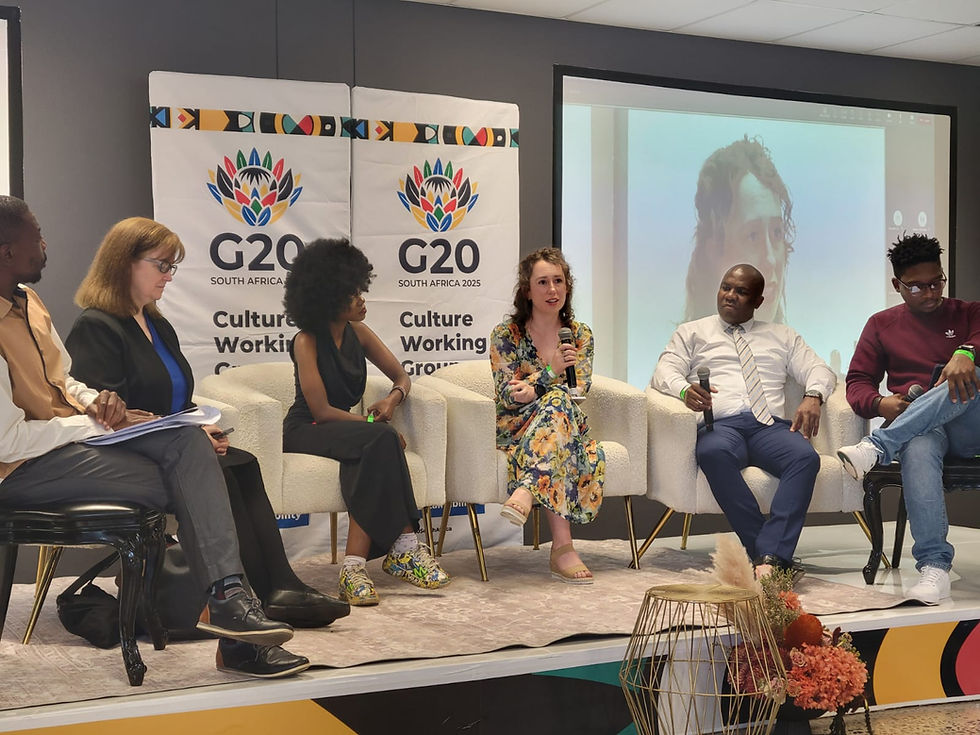
EthicEdge co-founder and co-director, Dr Cindy Friedman, recently represented South Africa at the G20 Culture Working Group Side Event on Economic and Digital Rights in the Cultural and Creative Sector, held in KwaZulu-Natal on 24 October. The event convened global thought-leaders, policymakers and creatives to explore how culture, technology and rights intersect, and how human creativity must be protected in a rapidly shifting digital economy.
Dr Friedman was invited to join a panel titled “The Digital Dimension: Fair Remuneration in Streaming, Algorithm Transparency, and Ethical AI”. Her contribution’s central message emphasised that human creativity and authorship must remain respected, valued and protected, even as AI and digital platforms reshape how culture is produced, distributed and rewarded.
Why the event mattered
Cultural and creative workers worldwide drive innovation, imagination, and social cohesion yet, too often, they face precarious employment, unequal pay, weak intellectual property protections, and limited access to economic and social rights. These challenges are particularly acute for women, youth, and marginalised groups, and they are compounded by geographic, racial, linguistic, and gender inequalities.
Digital transformation, globalisation, and AI have created unprecedented opportunities for creative entrepreneurship, skills development, and international reach. Yet, these shifts have also intensified risks: unfair remuneration, algorithmic bias against local content, and threats to copyright and authorship are now pressing global concerns.
International frameworks such as the UNESCO Recommendation on the Status of the Artist (1980), the 2005 Convention on the Diversity of Cultural Expressions, and ILO standards on decent work provide a foundation for advancing creators’ rights. However, without robust structural responses, these inequalities threaten both the sustainability of creators’ livelihoods and the cultural diversity that underpins democratic, just, and prosperous societies.
The Seminar’s Purpose
The G20 Side Event served as a platform to exchange knowledge, highlight best practices, and explore policy strategies to:
Ensure fair pay, decent work, and sustainable conditions for cultural workers in both traditional and digital spheres.
Strengthen global frameworks safeguarding creators’ rights and improve their implementation across G20 nations.
Compare regional contexts to identify gaps and opportunities in addressing inequalities, rights, and market access.
Showcase national policies that support fair remuneration, social protection, and bargaining power for creators.
Address the digital transformation of culture by examining streaming remuneration, algorithm transparency, and ethical AI integration.
Promote equity, inclusion, and environmental responsibility within cultural labour policies.
Panel on the digital dimension
In “The Digital Dimension: Fair Remuneration in Streaming, Algorithm Transparency, and Ethical AI,” panellists debated how the digital revolution has transformed cultural production and often compromised creators’ livelihoods. Key discussions included:
How creators can secure fair remuneration in streaming and digital distribution.
The need for transparency in algorithms that determine visibility, discoverability, and payment.
Ethical AI integration that enhances rather than replaces human creativity.
Can AI Be Truly Creative?
Dr Cindy Friedman challenged the audience with a provocative question: Can artificial intelligence be truly creative? While AI can generate music, art, and writing, Dr Friedman emphasised that true creativity is far more than mere output, it is born from lived experience, intention, and meaning. AI may mimic styles and even produce surprising results, but it cannot replicate the human context, imagination, or emotional depth that define authentic creativity. Protecting human authorship is, therefore, not only a matter of intellectual property, but a way in which to protect what makes us distinctly human. In an era where the line between human and machine is increasingly blurred, safeguarding authorship becomes a crucial way to preserve our humanity, our stories, and the values embedded in our creative work. As she noted towards the end of her presentation: “Safeguarding creative authorship honours the uniquely human imagination and the distinctive process that only we can bring to life”.
A Landmark Case: Zakes Mda, Anthropic, and the Stakes for Authors
The urgency of Dr Friedman's message was reflected in her discussion about the recent Bartz v. Anthropic settlement. In October 2025, South African author Zakes Mda was among those benefiting from a US$1.5 billion settlement after the AI company used his books without permission. Six of Mda’s novels had been incorporated into AI training datasets without consent.
Mda’s experience highlights the global challenges Dr Friedman raised: creators must be fairly compensated, authorship must be respected, and digital platforms and AI systems must operate with accountability.
Looking Ahead: Creativity, Ethics, and Our Digital Future
Dr Friedman's participation at the G20 represents both an honour and a recognition of EthicEdge and, more broadly, of South Africa’s growing voice in global debates on ethical AI, digital rights, and cultural creativity. By grounding high-level discussions in real-world cases like Mda’s, Dr Friedman's contribution to the panel transformed abstract principles into tangible stakes. Ethical AI is not merely a technical issue; it is also a cultural and economic imperative. When authors’ works are used without permission or algorithms marginalise local creators, the challenge is more than about intellectual property rights, but also about human dignity and creative freedom.
Dr Friedman’s message is clear: creativity is a cornerstone of what it means to be human. In the age of AI, protecting that creativity is essential to protecting our very humanity. Fair remuneration, algorithmic transparency, respect for authorship, and ethical AI must advance together. At EthicEdge, we remain committed to advocating for a digital future where technology serves people, by promoting ethical practices in the design, implementation and use of AI and digital platforms.



Comments